My Treasure

What kind of treasure does your music collection have? A readily available resource called Discogs will help you out almost in an instant. It is quite rare that the bar code off the back of your record or CD, or in case you own records from the pre-bar code era, the catalogue numbers will not be found by Discogs. Almost everything will have a valuation, almost everything will have a history of buying and selling.

When you think of it, that’s how it should be but in my experience, that’s not how it has always been. For me, my current situation of being firmly rooted in a very pleasant country on the right side of the Iron Curtain, is a gift in itself and time has put an abyss between my days in the Soviet Union’s city of Gorky, back then, the city of the Academician Andrey Sakharov’s guarded exile.

In those days owning a record meant being part of a slightly parallel reality, at times more rewarding, at times more dangerous and often times heart-breaking. Danger could come from the police (then – militia) raiding a weekly gathering of owners of records and those wishing to own them or tape them. Danger could come from the small but well organized groups of youths who did not care about the music but were eager to promptly separate isolated record owners from the rest and quickly dispossess them of their records, most of the time with a bit of physical violence to improve the effectiveness of the rather unilateral transaction. Heartbreak could come from being tricked into buying a record to discover that the labels had been switched and what you paid for dearly was in fact worthless. Heartbreak could come from the necessity to ditch your very valuable records while running downhill lest you be caught in possession by an eager volunteer or Mr Policeman to avoid the follow up in school or university, which involved explanations of varying degrees of gravity to panels of varying degrees of importance to help them understand why the young man standing before the esteemed panel chose to come into questionable ownership of a piece of anti-Soviet propaganda.

Back in the mid and late eighties I spent several years in the gradually thawing environment with my best friend whose parents generously financed about 90 per cent of our acquisitions that together amounted to a rather modest collection of less than moderate value. To us it was a treasure nonetheless. We had Deep Purple, Jethro Tull, Pink Floyd, Rainbow and even though some of the gatefolds had been cut out by previous listeners and the records would be sometimes graded as VG at most, we played them, talked about them, researched them and were very happy.

I still have a couple of records that survived the 90s when the vinyl was pronounced dead. They remind me of Pavel, my friend who died in an accident in his prime. It reminds me of the time when what we heard meant more than what it cost.

So I thought to put together a series of illustrated stories that would lead the way through my greatly expanded collection that I can keep and not worry about running away from the police. How to build this path is a question because for a disorganized person like me, my collection is relatively well organized, alphabetically and chronologically. Plus, working my way through every Jethro Tull record would make me a competitor to Seva Novgorodsev, whose programmes on the BBC Russian Service I listened to every Friday at midnight and, I should add, who read two of my letters posted with rather little hope of them making it to London. They did.
Sign of The Times

For several years I had a simple weekend routine of going down to a newspaper kiosque in Rolle. There were several of them in Grand Rue, just a 10 minute walk from the flat and I normally picked up the Saturday issue of The Times and Financial Times Weekend issue. Those 2 papers gave me enough of leisure reading for a couple of days. Normally, I would go over the news, look through book reviews, read interviews and football analysis and previews. There would always be interesting periphery material too, from descriptions of remote destinations to business news and analysis, which never failed to make me feel guilty of not advancing my understanding of business matters to fully appreciate the contents of the business pages. Almost every weekend I would be guaranteed to be annoyed enough with what I read in the papers or the manner of reporting the news or a particular angle of approach to analysis.

Because of this habit, one of my presents for the 45th birthday was a copy of The Times dated June 2, 1973. To this day I have not taken it out of its pretty frame but I did go through the front page, of course, learning the obsolete news of the day I was born as reported in The Times. On that day Greece abolished the monarchy, a loaf of bread became half a penny more expensive and the top football flight adopted the rule of 3 clubs relegated to be replaced by 3 clubs promoted from the lower division. The football rule is still relevant as I write this.

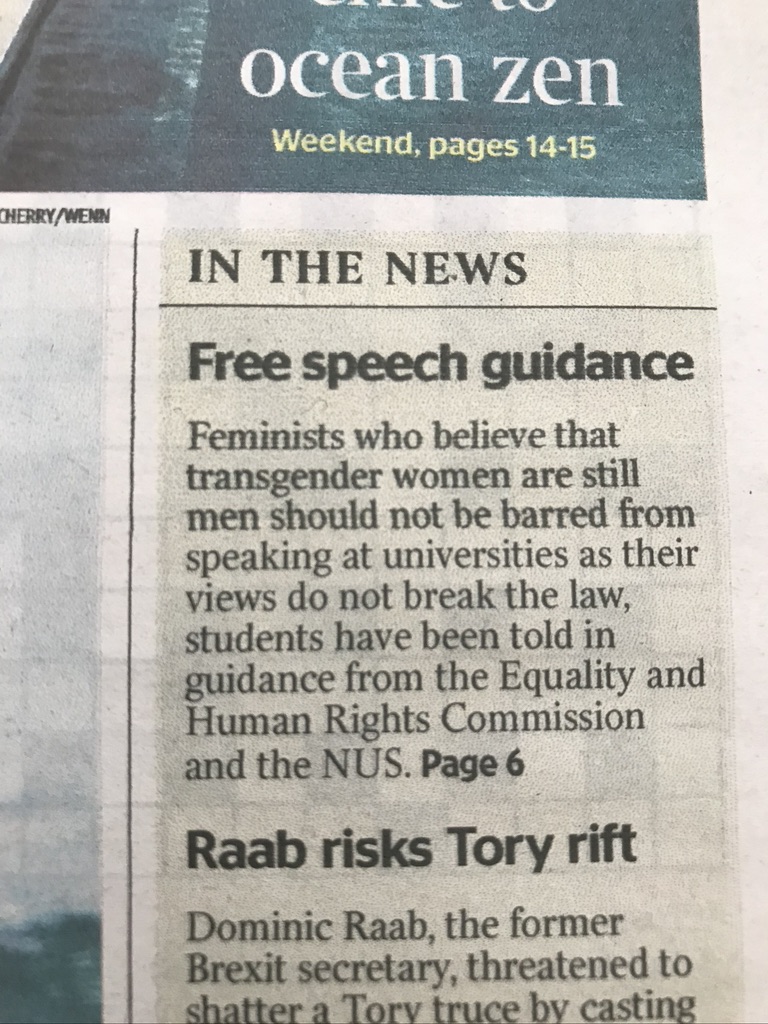
Then, in February 2019, after buying the usual set of papers, I looked at the front page of The Times to see something that I had to read more than once to make sense of it. I must admit, which I do without shame, that many of my readings did not help me understand what that particular piece of news really meant or why it had to be printed. However, that which was completely beyond my understanding quite unexpectedly shown a very bright light upon the source of my annoyance and irritation: I was completely out of time with the reality as reported by the papers.

Indeed, the world has changed in between the two issues of the Times, both published on a Saturday, leaving the news that I could understand and relate to, such as loaves of bread becoming more expensive or a country changing its format or the promotion and relegation rules, completely overshadowed by this free speech guidance:

Feb 7, 2019

Free speech guidance:

Why would anyone want to see that on the front page of a newspaper, I cannot say. Uncaring as I am about the situation, I am left wondering if the same free speech guidance concerns non-feminists with the same beliefs or they would be treated differently. I am uncertain if the Equality and Human Rights Commission and the NUS ever considered non-feminists. Why any views about transgender women would break the law is another mystery. I have not thought much about transgender women, to be quite honest, but if I were to make a start, was I putting myself in a legally dangerous situation by believing transgender women were tractors? or, maybe strawberries? Much as I was ignorant, I did not bring myself to read the full feature, partly because transgender women presented no interest to me, but more largely because I could not help concluding that this version of the reality was not one I was willing to accept.

The Worst Gigs I’ve Been To

I’ve been blessed to have been to some bad gigs. To me, this is a blessing because I might have been to none, had things gone the way they were supposed to early on. Some of the remarkably bad gigs are now faded in memory, like the one my friend Dima and I went on April 1 of some year between 1986 and 1990 in Nizhny Novgorod, which would have been in the Philharmonic Hall in the NN Kremlin. The concert was a compilation of stand up performances in the classical Soviet monologue format delivered by TV people from Vzglyad and a performance by the band Okno, who were famous for a brief moment. However bad the whole thing was, it did not feel like that at the time. There were jokes about police packing a Japanese filming crew believing they were Kazakh, the funny bit contained in the firm Soviet belief that arresting Kazakhstanis was okay (they were us, Soviets) and arresting Japanese was unthinkable (they were them, not us). I believe, there were anecdotes about Nikita Bogoslovsky – or it may have been himself – one being the story of him playing a piano hoisted to the fifth floor and causing a panic attack from the target attempting a morning tea. And then Okno came to play their set that now looks charmingly bad. Charming because I was 15 or 16 at the time and bad because it was simply horrible. But then we walked out into the night and walked all along the embankment in the softest snow that had covered everything and kept on falling. Well worth it, it was.

Same venue hosted a truly monstrous performance by Sergey Manukian, billed as a fantastic jazz pianist. I swear this was the only performance ever where every note was wrong and misplaced. I escaped as soon as the intermission was announced.

The champion of misplaced everything was Patti Smith, performing in Geneva in a small very bourgeois theatre. This was the strangest experience. She came armed with a book and a son. Half of the performance was her reading her novel Just Kids and whenever her reading was not fluent she found nothing better than to state that “Bob Dylan fucks up his lyrics all the time” as if Dylan had any responsibility for her not being able to read. Then the son played the acoustic guitar and she sang a handful of hits with the mandatory Because the Night. And then she concluded with Power to the People, complete with her shaking her fist in solidarity with the people who had no power at the people who actually had the power and on average carried 20 kilos of extra weight and whose cumulative wealth could feed all of the African continent for years. These people had the power already.