Better Not to Meet the Magicians

Not long ago, going through my records, I pulled out a bootleg of Coil live in Moscow. I had to look up the date: 15 September 2001, DK Gorbunova, the old Gorbushka. Four days after the towers came down in New York. The date I had forgotten. Nothing else about that night needed looking up.

My friend Andrey had a friend, Ivan Pavlov, who records as CoH and who opened the evening. Ivan put us on the list. What followed was not a concert in any sense I had known until then. The sound was not only heard; it was felt by the body, through the floor and in the chest. The visuals swallowed the hall. The band stood on stage in overalls smeared with what looked like blood, playing with light bulbs as if they were instruments, which that night they were. I walked out a different listener from the one who had walked in.

What I did not know until later was that Andrey had been expected backstage. He never went. Another friend from Nizhny Novgorod who did make it through brought him souvenirs at the train afterwards. Andrey did not mind in the least. The impression was so immense, he said, that he preferred not to meet the magicians in person. A quarter of a century on, I think he was right, and I think his choice says something about what music was for us then.

Lausanne, June 2026

This summer I went to see Cabaret Voltaire at Les Docks in Lausanne, part of what has been billed as their farewell run. Richard H. Kirk died in 2021; the name is now carried by Stephen Mallinder and Chris Watson, the two surviving founders. It was a good night. And yet I could not shake a thought that has been following me around for some time: that I was watching the closing chapter of a way of making music that will go when the bands who invented it in the late seventies and eighties go, words spoken or sung over short, repetitive compositions.

The new releases

The same thought returns every time I go through the lists of new releases and reissues. The reissues are where the energy is, which is already telling. As for the new music, it is obvious that there are loads of young men and women who can play their instruments with a virtuosity that would have made some of my heroes blush. It is equally evident that their music does not touch me the way The Beatles, Bob Dylan, Weather Report, Miles Davis, The Clash or The Stranglers did, and still do. Two of those names made music with barely a word in it, so this is not only about lyrics. It is about necessity: the sense that the record had to exist, that somebody would have burst had they not made it.

Almost any month’s list will give you a reissue of a record that changed popular culture when it first came out. Some artists managed that with every album; others released masterpieces and cultural phenomena interspersed with more pedestrian efforts. But they had something to say and something to play. Robert Fripp or Klaus Schulze, Leonard Cohen or Fabrizio De André: without fail, they made music. We are still living in a time when my generation remembers books, not texts; albums, not dropped tracks.

Last year I took a long walk with the new album by Geese, a band much praised by people whose taste I usually respect. Some of the music was perfectly listenable. The lyrics, though, struck me as so infantile and so divorced from any recognisable reality that a second listen was out of the question.

Recycling

What I hear instead, more and more, is the past being recycled: in the music, in the lyrics, even in the names of the bands. Bob Vylan clearly took a great deal of effort to come up with. Greta Van Fleet borrowed their name, innocently enough, from an elderly woman in their Michigan home town, yet the band sounds so much like Led Zeppelin that the name starts to feel like one more quotation. Even when it is not intentional, it reads like a grim reminder of how little is left to invent.

I should be honest here, because the charge cuts both ways. Cabaret Voltaire took their name from Hugo Ball’s Dada club, which opened in Zurich in 1916. My heroes borrowed too. The difference, I think, is direction. A Sheffield trio naming itself after a Dada cabaret in the 1970s was making a declaration of intent: it pointed forward, toward noise, chance and provocation. A pun on Dylan points only back at Dylan.

I know that every generation says this, and that somewhere, in rooms I no longer go to, someone is probably having their own Gorbushka night right now. I would be glad to be proven wrong. But I keep coming back to Andrey on that platform, turning over the souvenirs he had chosen not to collect in person. The magicians were real enough that meeting them might have diminished them. I find it hard to imagine anyone today needing that kind of protection from their favourite band.
My Treasure Cont. 3

I needed to look at the Discogs catalogue to remind myself when exactly I got this next record – Acintya – La Cité Des Dieux Oubliés. This must have been on a day when I was digging online through the Ricardo offers in search of something rare and interesting in 2023. I am not that big of a collector and this feeling of wanting to find something in a sea of nothing is one that I share with the more successful ones.

Undoubtedly, the only record I have that is made by a band from Nancy, France. The boy from 1986 that I once was would have immediately offered the only known fact about this place in France: that’s where Michel Platini started his professional career in 1970s. Acintya too started in 1970s and remains a progressive rock fan possible interest, not a music fan’s necessity.

The name of the band (Achnitya in English) is the name of the supreme god of Indonesian Hinduism, particularly revered on the island of Bali and equivalent to the metaphysical concept of Brahman of Indian Hinduism (thank you Wikipedia).

The record is the only one the band ever made. Two reviews I was able to find note the eclecticism of the compositions, influences of the classical and electronic music, a great display of virtuosity from the violinist Philippe Clesse and the keyboardist Philippe De Canck and rate it at about 3 and 3.5 out of five.

I would say that this is the kind of record I might play when stumbling upon it late at night, completely oblivious to what the music sounds like but willing to play it just because it will take me back to this evening when I was digging through Ricardo’s virtual crates in search of something curious.

My Treasure cont. 2

I can swear that the Accept logo, with the A and the T joined up, was by far the most popular, or maybe the only one that was omnipresent on every wall in Gorky. God knows why. I was never close to anyone who back then would have a bunch of Accept records. In fact, years before my purchasing power squeezed its way up into the theoretical possibility of buying one, every boy in the class was supposed to select either “metal” or “wave” as their true style. Accept were metal. Wave was their compatriots Modern Talking or artists like CC Catch or the Austrian band Joy: Life is life, nah nah na-na-na.

Now, this particular album had the aura of the fruit forbidden twice. Metal was forbidden. In addition to that, even though none of us could make out any words, let alone sense from the lyrics, the cover of the record that circulated in black-and-white photos that were taken from other black-and-white photos, showed the band dressed up as Russian White Army officers and the title made everyone relate to it immediately. It was Russian Roulette. Russian written in English was cool.

And it goes without saying that if Accept made any videos (I don’t know if they did), they would not and could not be shown on the Soviet TV. I can’t remember if that’s my own invention or someone else shared their fantasy with me, but the mental image I have when listening to this next song was that of their singer taking out an alarm clock out of his pocket, showing seconds left before the end of the world in a nuclear attack and proceeding to scream the refrain.

The record next to it is AC/DC’s live record that made its way into my collection just because I could not have passed on the constant companion to my running. These live performances that were later embellished in the studio are not probably the most popular amongst the AC/DC fans. The drummer here is Chris Slade, the shaven head Shrek-like gentleman previously known for his work with Manfred Mann’s Earth Band, and not the more original drummer who much later was sentenced for trying to get a contract out on someone. I do like AC/DC although stating that I am a fan would be disrespectful to the many die-hards the band so richly deserves.

By trial and error, this AC/DC live album from 1990 proved to be a near perfect soundtrack to my runs that at the peak were typically 16km twice a week and anything between 10km and 13 km once a week. I removed several tracks (Fire Your Guns did not sound right and the intro to The Razor’s Edge was too long) but I loved listening to the 14 minute version of Jailbreak that most people would probably find boring. Not me. Given my lack of musical ability and intelligence, I grew to love the lengthy section where Malcolm Young is producing a powerful but minimalist demonstration of economical rhythm guitar playing and his brother is weaving increasingly powerful but simple solo phrases in parallel.

I was lucky enough to catch the disintegrating band live on a show in Zurich on their Rock or Bust tour. Malcolm was no longer touring but still alive, I believe. The stadium was packed with people way past their youth and presentable looks. There were lines for the blue toilet cabins. Bald and fat men playing air guitars in the aisles on their eighth trip to get more beer looked ugly. Just like with any stadium concert, the impression I got was being sat on the 9th floor balcony in my block of flats in Gorky and looking at a bunch of guys striking poses a block away.

But just before AC/DC went into Thunderstruck, probably, my favourite song from their vast repertoire, there was thunder and lightning and the heavens opened. It was a summer night and after the mandatory salute, we went to the car park to drive back home. By the time we got to the car, we were completely soaked and happy. This, quite possibly, was the best stadium gig experience for me.

My Treasure

What kind of treasure does your music collection have? A readily available resource called Discogs will help you out almost in an instant. It is quite rare that the bar code off the back of your record or CD, or in case you own records from the pre-bar code era, the catalogue numbers will not be found by Discogs. Almost everything will have a valuation, almost everything will have a history of buying and selling.

When you think of it, that’s how it should be but in my experience, that’s not how it has always been. For me, my current situation of being firmly rooted in a very pleasant country on the right side of the Iron Curtain, is a gift in itself and time has put an abyss between my days in the Soviet Union’s city of Gorky, back then, the city of the Academician Andrey Sakharov’s guarded exile.

In those days owning a record meant being part of a slightly parallel reality, at times more rewarding, at times more dangerous and often times heart-breaking. Danger could come from the police (then – militia) raiding a weekly gathering of owners of records and those wishing to own them or tape them. Danger could come from the small but well organized groups of youths who did not care about the music but were eager to promptly separate isolated record owners from the rest and quickly dispossess them of their records, most of the time with a bit of physical violence to improve the effectiveness of the rather unilateral transaction. Heartbreak could come from being tricked into buying a record to discover that the labels had been switched and what you paid for dearly was in fact worthless. Heartbreak could come from the necessity to ditch your very valuable records while running downhill lest you be caught in possession by an eager volunteer or Mr Policeman to avoid the follow up in school or university, which involved explanations of varying degrees of gravity to panels of varying degrees of importance to help them understand why the young man standing before the esteemed panel chose to come into questionable ownership of a piece of anti-Soviet propaganda.

Back in the mid and late eighties I spent several years in the gradually thawing environment with my best friend whose parents generously financed about 90 per cent of our acquisitions that together amounted to a rather modest collection of less than moderate value. To us it was a treasure nonetheless. We had Deep Purple, Jethro Tull, Pink Floyd, Rainbow and even though some of the gatefolds had been cut out by previous listeners and the records would be sometimes graded as VG at most, we played them, talked about them, researched them and were very happy.

I still have a couple of records that survived the 90s when the vinyl was pronounced dead. They remind me of Pavel, my friend who died in an accident in his prime. It reminds me of the time when what we heard meant more than what it cost.

So I thought to put together a series of illustrated stories that would lead the way through my greatly expanded collection that I can keep and not worry about running away from the police. How to build this path is a question because for a disorganized person like me, my collection is relatively well organized, alphabetically and chronologically. Plus, working my way through every Jethro Tull record would make me a competitor to Seva Novgorodsev, whose programmes on the BBC Russian Service I listened to every Friday at midnight and, I should add, who read two of my letters posted with rather little hope of them making it to London. They did.

What do you reach out for when you hear the word “culture”

In my recent Uncut issue I read a story about the inflatable pig Roger Waters had donated to a family in Chile and how rock music was the soundtrack of resistance during the Pinochet era. Interestingly, where the Pink Floyd record Animals would be immediately associated with an antitotalitarian protest for its obvious connection with Orwell’s 1984, the other bands that the protagonist mentions as inspiration are not so obvious: Genesis and King Crimson were not best known for political themes.

In my Soviet youth, any Western music was perceived as anti-Soviet. Despite the exceptions of Uriah Heep and Elton John who were allowed to perform in USSR, most of the rock music was either banned directly or deemed undesirable. Buying and trading records was a high adrenaline adventure, depending on the time and place and those involved in those clandestine trade fairs risked not only losing their collections but a more painful follow up as either administrative or criminal prosecution. My dear friend Valery Syrov, a conservatoire professor and the author of a very academic study of progressive rock, told me how he once had been asked to trade A Day At The Races by The Queen and got caught with it in a police raid. I started going to the record bazar in late 80s and narrowly missed the thrill of being chased by the police but I have vivid memories of BBC Russian Service programmes being suppressed and uninspired articles in the press that exposed the ideological warfare in which music groups were nothing but an imperialist weapon.

30 years later, in 2025, Russia is a state conducting an undeclared war in Ukraine and fighting most of the world on the ideological front again. Would King Crimson and Pink Floyd or their modern day equivalents again provide inspiration to people in Russia who do not accept the current regime? In a country where organisations and individuals are liberally labelled as foreign agents and undesired, would foreign cultural phenomena provide inspiration to resist the aggressive ideology of mysterious traditional values seemingly rejected everywhere except in Russia? I think the answer is no.

The Russian regime that settled in 2000 and seized total and complete control by 2025 has successfully implemented a strategy invented by their ancestors, Bolsheviks, by throwing out the ideology that once failed them. Marxism and Leninism are of no use to anyone now, just as their ill-conceived and quite sickly bastard child, scientific atheism (a university discipline, no less). They have been replaced  with nationalism, religion and complete absence of interest in learning anything new. Where Soviet people had a level of culture and education, the Russian people of 2025 have been successfully formatted into a simplified mass that is free in using profanity and prison jargon everywhere because even the mass media speak to them in this same language. My son sent me a link to watch a film Mr No One Against Putin and I was shocked. Not by the how children are brainwashed by the teachers but by how the teachers communicate between themselves and with the kids. If pedagogues cannot express themselves without the use of profanity, brainwashing is secondary.

King Crimson and Pink Floyd are no longer bands that created magic and made statements, they are products for consumption and there are easier and more satisfying products in the market right now. Police aren’t chasing sellers of Iron Maiden records, they are busy pulling books by Russian foreign agents off the shelves and making it impossible for artists who disagree with or protest against the Russian politics to perform or even exist in the country.

My 2025 Records

Ever since last year, I’ve tried to be meticulous in keeping track of the records I’ve bought, played and liked. Or not. A glance at the 2025 report says to me that I added 134 new titles to the inventory, of which 15 were new releases. Some of these 15 were re-issues of older material, e.g., New Model Army’s The Love of Hopeless Causes, or Lianne La Havas’ Is Your Love Big Enough?, or The Durutti Column’s debut album, The Return of the Durutti Column.

I must say that the 2025 new records have not swept me off my feet. In fact, I’ve been thinking if that’s a matter of becoming older and grumpier: I do find the reissues sections in Record Collector or Uncut more interesting. The mere fact that there are acts that call themselves Bob Vylan is telling enough.

However, I have my 2025 highlights and disappointments and in-betweens.

Solace of the Mind by Amina Claudine Myers is beautiful. Red Hook Records is a label worth collecting, actually. There is a concept and a logic and a style there – even though my exposure to their output has been limited for reasons I won’t go into but they have nothing to do with the label.

Another heavenly record is After the Last Sky by Anouar Brahem, Anja Lechner, Django Bates and Dave Holland. It takes my breath away. And, in the light of Jack DeJohnette’s recent passing, I always remember how fortunate I was to see Anouar Brahem perform live with the same band except that Mr DeJohnette was playing drums in lieu of Anja Lechner’s viola.

Lera Lynn and Blixa Bargeld had a self-released EP each and I loved both of them. Lera Lynn’s original material is art with the confidence of a big artiste and Blixa’s huge personality is enough to not feel awkward in David Bowie’s shoes. I found it genius that Mr Bargeld chose the chamber format of a duo with a pianist to deliver 4 covers of not necessarily obvious material – and Heroes never sounded with a better German. Yet, there are two unmistakable vocal solos that only Blixa is capable of. Actually, I will do a little search to see if anyone else covered Subterraneans (which album is it off, would you know without looking it up :)?)

Weather Station did not cut it for me. A lot of words, a lot of notes not amounting to substance. The previous records were remarkable, this one hasn’t grown on me, and I hope that “yet” is missing in this phrase.

Mogwai’s Bad Fire was one of the in-betweens – I might re-christen it into Purgatory. Allbarone by Baxter Dury was exactly in the way Baxter Dury is for me: a lot of appeal and interest but only before he strikes a pose and takes his jacket off his shoulders to put it back on to drop it off again – and again, finding nothing better to do while the ladies in his band sing the same lines for about fifteen times during a 2 minute 30 seconds piece.

I will mention that Boris Grebenschikov’s Square Root From the Sun has a majestic version of Angel orchestrated by Tony Visconti and a piece of absolute beauty in 5 am. But this beauty is only for the exclusive audience of Russian speakers on the fringes of the war-mongering nation that is rushing towards the open gates of the newly built concentration camp under construction. Amongst the modest benefits this small audience can be happy with is the presence of Tony Visconti, of course – and who wouldn’t be happy about it.

I am.

Sign of The Times

For several years I had a simple weekend routine of going down to a newspaper kiosque in Rolle. There were several of them in Grand Rue, just a 10 minute walk from the flat and I normally picked up the Saturday issue of The Times and Financial Times Weekend issue. Those 2 papers gave me enough of leisure reading for a couple of days. Normally, I would go over the news, look through book reviews, read interviews and football analysis and previews. There would always be interesting periphery material too, from descriptions of remote destinations to business news and analysis, which never failed to make me feel guilty of not advancing my understanding of business matters to fully appreciate the contents of the business pages. Almost every weekend I would be guaranteed to be annoyed enough with what I read in the papers or the manner of reporting the news or a particular angle of approach to analysis.

Because of this habit, one of my presents for the 45th birthday was a copy of The Times dated June 2, 1973. To this day I have not taken it out of its pretty frame but I did go through the front page, of course, learning the obsolete news of the day I was born as reported in The Times. On that day Greece abolished the monarchy, a loaf of bread became half a penny more expensive and the top football flight adopted the rule of 3 clubs relegated to be replaced by 3 clubs promoted from the lower division. The football rule is still relevant as I write this.

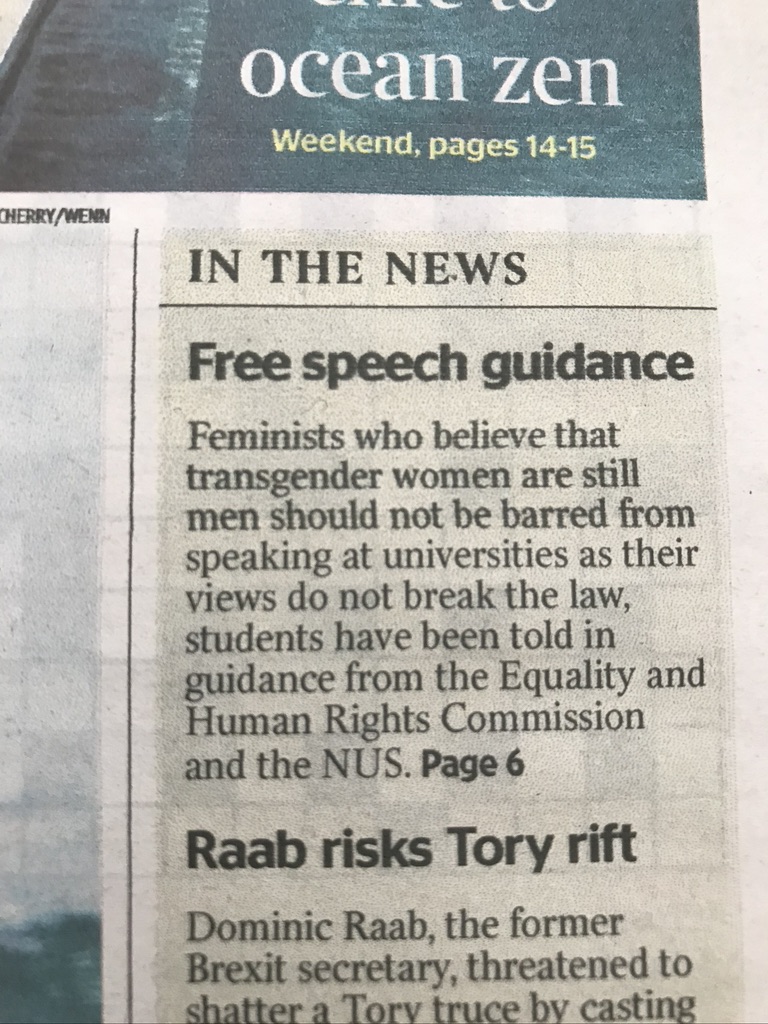
Then, in February 2019, after buying the usual set of papers, I looked at the front page of The Times to see something that I had to read more than once to make sense of it. I must admit, which I do without shame, that many of my readings did not help me understand what that particular piece of news really meant or why it had to be printed. However, that which was completely beyond my understanding quite unexpectedly shown a very bright light upon the source of my annoyance and irritation: I was completely out of time with the reality as reported by the papers.

Indeed, the world has changed in between the two issues of the Times, both published on a Saturday, leaving the news that I could understand and relate to, such as loaves of bread becoming more expensive or a country changing its format or the promotion and relegation rules, completely overshadowed by this free speech guidance:

Feb 7, 2019

Free speech guidance:

Why would anyone want to see that on the front page of a newspaper, I cannot say. Uncaring as I am about the situation, I am left wondering if the same free speech guidance concerns non-feminists with the same beliefs or they would be treated differently. I am uncertain if the Equality and Human Rights Commission and the NUS ever considered non-feminists. Why any views about transgender women would break the law is another mystery. I have not thought much about transgender women, to be quite honest, but if I were to make a start, was I putting myself in a legally dangerous situation by believing transgender women were tractors? or, maybe strawberries? Much as I was ignorant, I did not bring myself to read the full feature, partly because transgender women presented no interest to me, but more largely because I could not help concluding that this version of the reality was not one I was willing to accept.

Almost Live Music

Many winters ago I was listening to the BBC Russian Service. Seva’s programmes were the most important but tuning in early, I listened to the literary programmes (Yury Daniel’s short story Hands opened a very important door for me) and also, the jazz programme by Alexei Leonidov. I can’t describe the feeling of hearing the alien sounds of modern jazz through the roughness of suppressed radio waves. In combination it created its own art form.

I saw Alexei Leonidov when he transformed back into Leo Feigin in the Dom Cultural Centre in Moscow, at the Leo Records festival.

A few years back, right about this time, I received a package from Leo to be delivered to Moscow to the Wyrgorod publishing. Leo sent me 2 CDs as a token of thanks for being the delivery boy – he didn’t have to do that.

Now I am awaiting for a bigger package from Leo Feigin, having got 40 CDs of music in what I hope to not be the final sale of Leo Records. And I am playing the one I got some 6 years back: Last Train from Narvskaya. It is beautiful.

Bring Football Back

Over the past few days I’ve seen multiple discussions about whether or not the disallowed Liverpool goal should have stood, among the arguments rather violently offered by Liverpool supporters were “Donnarumma had committed himself fully by jumping for the ball” or “Robertson was not interfering with the keeper”. This, again, made me think – reverse all of the changes of the past 30 years or so to let people watch the game, undo the business. This won’t happen of course. But if it did, here’s a few things that would be better.

For starters, all these conversations about interference or blocking the view or being actively engaged in the game would go away. Robertson was offside.

Players would become better readers of the game. I think of the times when the game was slower but both defensive and attacking players had to be a lot more coordinated to either beat or trap the opposition by the offside rule.

Five substitutions is a joke. It takes a lot from the managers’ skillset to make the right substitution to change the formation/tactics, to turn the game. Seeing managers taking off their centre halves because they can is pathetic.

VAR needs to go.

A handball is a handball and this ends all discussions about “natural position of the arm”. Handling the ball is a foul.

And please tell me what was wrong with the kick off rule where the ball had to be moved in the direction of the opposition’s goal? Why did this have to change? So that people could see someone score with a direct kick? How many of those have we seen and how many of those do we actually want?

And please please please, don’t let other innovators like Arsene Wenger anywhere near the slightest opportunity of suggesting further changes.