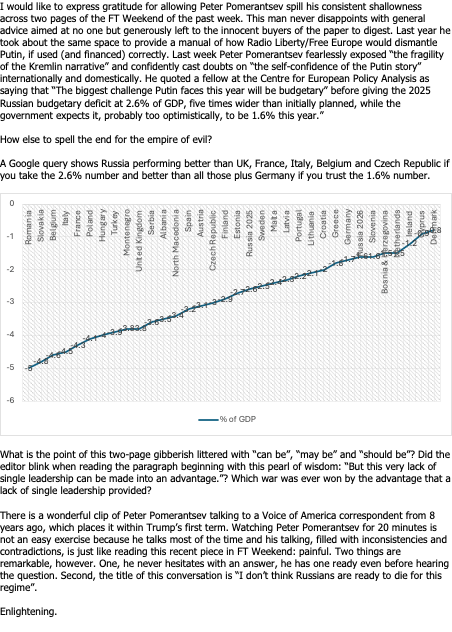
My 2025 Records

Ever since last year, I’ve tried to be meticulous in keeping track of the records I’ve bought, played and liked. Or not. A glance at the 2025 report says to me that I added 134 new titles to the inventory, of which 15 were new releases. Some of these 15 were re-issues of older material, e.g., New Model Army’s The Love of Hopeless Causes, or Lianne La Havas’ Is Your Love Big Enough?, or The Durutti Column’s debut album, The Return of the Durutti Column.

I must say that the 2025 new records have not swept me off my feet. In fact, I’ve been thinking if that’s a matter of becoming older and grumpier: I do find the reissues sections in Record Collector or Uncut more interesting. The mere fact that there are acts that call themselves Bob Vylan is telling enough.

However, I have my 2025 highlights and disappointments and in-betweens.

Solace of the Mind by Amina Claudine Myers is beautiful. Red Hook Records is a label worth collecting, actually. There is a concept and a logic and a style there – even though my exposure to their output has been limited for reasons I won’t go into but they have nothing to do with the label.

Another heavenly record is After the Last Sky by Anouar Brahem, Anja Lechner, Django Bates and Dave Holland. It takes my breath away. And, in the light of Jack DeJohnette’s recent passing, I always remember how fortunate I was to see Anouar Brahem perform live with the same band except that Mr DeJohnette was playing drums in lieu of Anja Lechner’s viola.

Lera Lynn and Blixa Bargeld had a self-released EP each and I loved both of them. Lera Lynn’s original material is art with the confidence of a big artiste and Blixa’s huge personality is enough to not feel awkward in David Bowie’s shoes. I found it genius that Mr Bargeld chose the chamber format of a duo with a pianist to deliver 4 covers of not necessarily obvious material – and Heroes never sounded with a better German. Yet, there are two unmistakable vocal solos that only Blixa is capable of. Actually, I will do a little search to see if anyone else covered Subterraneans (which album is it off, would you know without looking it up :)?)

Weather Station did not cut it for me. A lot of words, a lot of notes not amounting to substance. The previous records were remarkable, this one hasn’t grown on me, and I hope that “yet” is missing in this phrase.

Mogwai’s Bad Fire was one of the in-betweens – I might re-christen it into Purgatory. Allbarone by Baxter Dury was exactly in the way Baxter Dury is for me: a lot of appeal and interest but only before he strikes a pose and takes his jacket off his shoulders to put it back on to drop it off again – and again, finding nothing better to do while the ladies in his band sing the same lines for about fifteen times during a 2 minute 30 seconds piece.

I will mention that Boris Grebenschikov’s Square Root From the Sun has a majestic version of Angel orchestrated by Tony Visconti and a piece of absolute beauty in 5 am. But this beauty is only for the exclusive audience of Russian speakers on the fringes of the war-mongering nation that is rushing towards the open gates of the newly built concentration camp under construction. Amongst the modest benefits this small audience can be happy with is the presence of Tony Visconti, of course – and who wouldn’t be happy about it.

I am.

Sign of The Times

For several years I had a simple weekend routine of going down to a newspaper kiosque in Rolle. There were several of them in Grand Rue, just a 10 minute walk from the flat and I normally picked up the Saturday issue of The Times and Financial Times Weekend issue. Those 2 papers gave me enough of leisure reading for a couple of days. Normally, I would go over the news, look through book reviews, read interviews and football analysis and previews. There would always be interesting periphery material too, from descriptions of remote destinations to business news and analysis, which never failed to make me feel guilty of not advancing my understanding of business matters to fully appreciate the contents of the business pages. Almost every weekend I would be guaranteed to be annoyed enough with what I read in the papers or the manner of reporting the news or a particular angle of approach to analysis.

Because of this habit, one of my presents for the 45th birthday was a copy of The Times dated June 2, 1973. To this day I have not taken it out of its pretty frame but I did go through the front page, of course, learning the obsolete news of the day I was born as reported in The Times. On that day Greece abolished the monarchy, a loaf of bread became half a penny more expensive and the top football flight adopted the rule of 3 clubs relegated to be replaced by 3 clubs promoted from the lower division. The football rule is still relevant as I write this.

Then, in February 2019, after buying the usual set of papers, I looked at the front page of The Times to see something that I had to read more than once to make sense of it. I must admit, which I do without shame, that many of my readings did not help me understand what that particular piece of news really meant or why it had to be printed. However, that which was completely beyond my understanding quite unexpectedly shown a very bright light upon the source of my annoyance and irritation: I was completely out of time with the reality as reported by the papers.

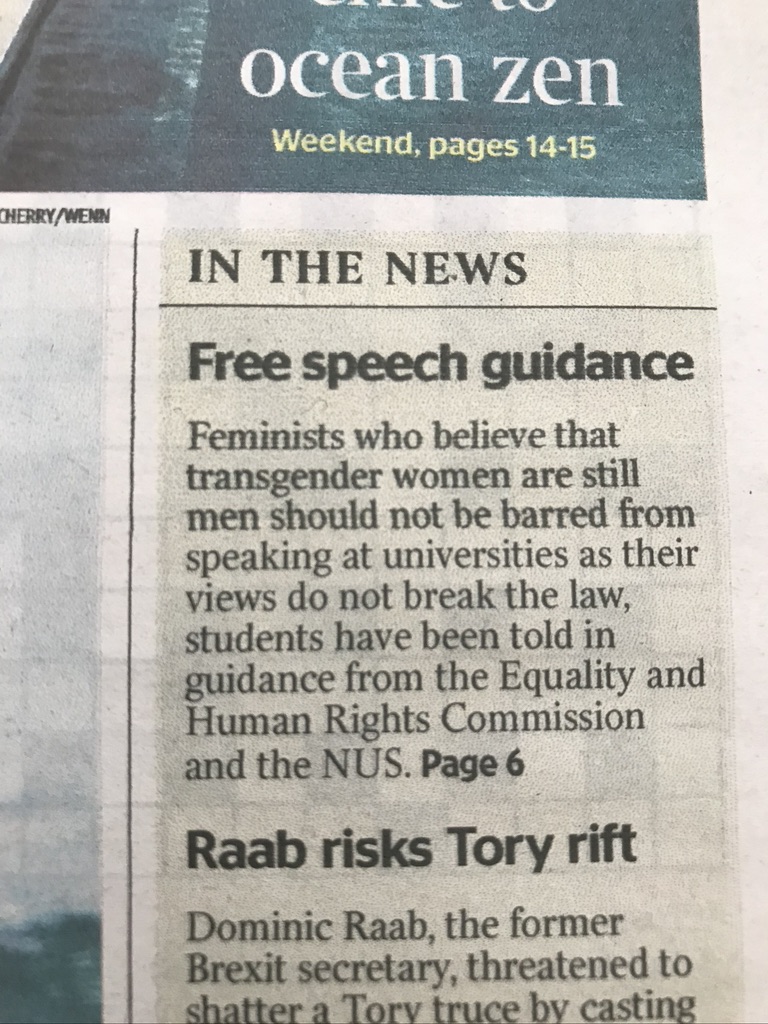
Indeed, the world has changed in between the two issues of the Times, both published on a Saturday, leaving the news that I could understand and relate to, such as loaves of bread becoming more expensive or a country changing its format or the promotion and relegation rules, completely overshadowed by this free speech guidance:

Feb 7, 2019

Free speech guidance:

Why would anyone want to see that on the front page of a newspaper, I cannot say. Uncaring as I am about the situation, I am left wondering if the same free speech guidance concerns non-feminists with the same beliefs or they would be treated differently. I am uncertain if the Equality and Human Rights Commission and the NUS ever considered non-feminists. Why any views about transgender women would break the law is another mystery. I have not thought much about transgender women, to be quite honest, but if I were to make a start, was I putting myself in a legally dangerous situation by believing transgender women were tractors? or, maybe strawberries? Much as I was ignorant, I did not bring myself to read the full feature, partly because transgender women presented no interest to me, but more largely because I could not help concluding that this version of the reality was not one I was willing to accept.

Almost Live Music

Many winters ago I was listening to the BBC Russian Service. Seva’s programmes were the most important but tuning in early, I listened to the literary programmes (Yury Daniel’s short story Hands opened a very important door for me) and also, the jazz programme by Alexei Leonidov. I can’t describe the feeling of hearing the alien sounds of modern jazz through the roughness of suppressed radio waves. In combination it created its own art form.

I saw Alexei Leonidov when he transformed back into Leo Feigin in the Dom Cultural Centre in Moscow, at the Leo Records festival.

A few years back, right about this time, I received a package from Leo to be delivered to Moscow to the Wyrgorod publishing. Leo sent me 2 CDs as a token of thanks for being the delivery boy – he didn’t have to do that.

Now I am awaiting for a bigger package from Leo Feigin, having got 40 CDs of music in what I hope to not be the final sale of Leo Records. And I am playing the one I got some 6 years back: Last Train from Narvskaya. It is beautiful.

Bring Football Back

Over the past few days I’ve seen multiple discussions about whether or not the disallowed Liverpool goal should have stood, among the arguments rather violently offered by Liverpool supporters were “Donnarumma had committed himself fully by jumping for the ball” or “Robertson was not interfering with the keeper”. This, again, made me think – reverse all of the changes of the past 30 years or so to let people watch the game, undo the business. This won’t happen of course. But if it did, here’s a few things that would be better.

For starters, all these conversations about interference or blocking the view or being actively engaged in the game would go away. Robertson was offside.

Players would become better readers of the game. I think of the times when the game was slower but both defensive and attacking players had to be a lot more coordinated to either beat or trap the opposition by the offside rule.

Five substitutions is a joke. It takes a lot from the managers’ skillset to make the right substitution to change the formation/tactics, to turn the game. Seeing managers taking off their centre halves because they can is pathetic.

VAR needs to go.

A handball is a handball and this ends all discussions about “natural position of the arm”. Handling the ball is a foul.

And please tell me what was wrong with the kick off rule where the ball had to be moved in the direction of the opposition’s goal? Why did this have to change? So that people could see someone score with a direct kick? How many of those have we seen and how many of those do we actually want?

And please please please, don’t let other innovators like Arsene Wenger anywhere near the slightest opportunity of suggesting further changes.

Quotes That Can’t Be Wasted

“At the beginning, I was like, OK? But then I couldn’t stop reading it. It’s like a Ryan Murphy series: not a lot to think about, but so entertaining”. – Maye Ruiz, responding to the question on “The best book I’ve read in the past year” in FT Weekend’s How To Spend It.

Two lines that manage to sum up both Ryan Murphy and Maye Ruiz, I suppose.

The Worst Gigs I’ve Been To

I’ve been blessed to have been to some bad gigs. To me, this is a blessing because I might have been to none, had things gone the way they were supposed to early on. Some of the remarkably bad gigs are now faded in memory, like the one my friend Dima and I went on April 1 of some year between 1986 and 1990 in Nizhny Novgorod, which would have been in the Philharmonic Hall in the NN Kremlin. The concert was a compilation of stand up performances in the classical Soviet monologue format delivered by TV people from Vzglyad and a performance by the band Okno, who were famous for a brief moment. However bad the whole thing was, it did not feel like that at the time. There were jokes about police packing a Japanese filming crew believing they were Kazakh, the funny bit contained in the firm Soviet belief that arresting Kazakhstanis was okay (they were us, Soviets) and arresting Japanese was unthinkable (they were them, not us). I believe, there were anecdotes about Nikita Bogoslovsky – or it may have been himself – one being the story of him playing a piano hoisted to the fifth floor and causing a panic attack from the target attempting a morning tea. And then Okno came to play their set that now looks charmingly bad. Charming because I was 15 or 16 at the time and bad because it was simply horrible. But then we walked out into the night and walked all along the embankment in the softest snow that had covered everything and kept on falling. Well worth it, it was.

Same venue hosted a truly monstrous performance by Sergey Manukian, billed as a fantastic jazz pianist. I swear this was the only performance ever where every note was wrong and misplaced. I escaped as soon as the intermission was announced.

The champion of misplaced everything was Patti Smith, performing in Geneva in a small very bourgeois theatre. This was the strangest experience. She came armed with a book and a son. Half of the performance was her reading her novel Just Kids and whenever her reading was not fluent she found nothing better than to state that “Bob Dylan fucks up his lyrics all the time” as if Dylan had any responsibility for her not being able to read. Then the son played the acoustic guitar and she sang a handful of hits with the mandatory Because the Night. And then she concluded with Power to the People, complete with her shaking her fist in solidarity with the people who had no power at the people who actually had the power and on average carried 20 kilos of extra weight and whose cumulative wealth could feed all of the African continent for years. These people had the power already.

A Glorious End

I was walking down to the post boxes by the railroad crossing and nearly reached the final bend of the road when I saw a cat carrying a mouse that was still alive but no longer showing active resistance. A car turned from the motorway and into our private drive, it went over the rails of the crossing: it was David, one of my nearest neighbours, coming back home from his work in Lausanne. David is a sales director selling Porsches. Porsche he was driving too, a Cayenne, I think.

The cat was in the middle of the drive when it realised that it was time to pull aside, just like I did, letting the car pass. The cat looked at the approaching Porsche and carelessly laid the mouse on the asphalt and then in two jumps went into bushes.

David was following the bend of the drive. He was steering the car gently, to let it flow all along the way, it was 300 metres to his house at most.

The right front wheel cracked the mouse’s head.

I picked up several meaningless advertisements and made my way back.

The mouse was lying in the drive. This was a life less ordinary, as they say. Avoiding a banal death by a predator by getting its skull crushed by the wheels of a Porsche Cayenne…

Live a little, die a little too.

Hopeless

I saw a piece on Kamala Harris recently, where she claimed that she’d not been done in politics and she might run for President of US again and the world should see a woman president soon.

I am wondering about this fixation on the gender.

So far, it’s been two female presidential candidates and both managed what the world was refusing to believe in: lose to Donald Trump.

I am sure, this does not sum it up for all women, but it certainly does for Kamala Harris.

Russian Liberals and Gaza

I’ve been wondering why the universally anti-Putin and pro-Ukraine Russians who have formed God knows which wave of immigration are equally universal in their support for Israel. Palestinians are not called other names but terrorists and the recognition of the state of Palestine by France, Canada and UK was met with a series of posts lamenting idiots in the West who can’t do anything about Putin and won’t do enough for Israel.

Is it because there are family ties? Probably.

Is it because there are friendly connections that are impossible to ignore? Probably.

A few months back, a dear friend of mine came visiting. Now 65 and a granddad, would he have any sympathy for the children suffering in Gaza? Not at all. In his view, all these kids can do, is assemble primitive missile launchers. I learned to stop certain conversations to avoid losing another friend of relative so I practised this recently acquired and much needed skill. This was about two weeks before I learned that a Lebanese family I’ve been talking to had lost their house after an Israel attack. They certainly weren’t terrorists. Their kids, a boy of 12 and a girl of 10, weren’t building missiles. Their aunt, a school teacher, advised me to try Amin Maalouf and never once went into radical Islamist rant. But there they were, in a sovereign country, left without a home, all the memories from their family taken forcibly away from them by a neighbouring aggressor state.

I suspect that peace and love can’t really interest people who choose hate.

Celebrating Stella Rimington’s Legacy Beyond Gender

Even though FT Weekend never fails to annoy, the August 9/10 2025 issue managed the usual from an unusual place, an obituary. In describing Stella Rimington’s career progression, the writer Helen Warrell first chose the title “First woman to lead Britain’s security agency MI5”, which does something that most professional organisations declare to not do, define employees by gender, race or religion. Stella Rimington must have been an outstanding professional, given that her rise to the MI5 chief position happened at the time when the Soviet Union lost the cold war, its many colonies and fell apart.

What irked me apart from the title was the following passage: “In 1986 she was promoted to the role of “K”, head of counter-espionage – a higher rank than any other woman in the agency, and a move that provoked disgruntled “mutterings” in the men’s toilets”.

I would be thrilled to know how Helen Warrell came into possession of such critical intelligence and who her sources were in those toilets.

It would appear that a great person’s passing is an event that may inspire a celebration of their achievements rather than provide a cheap reason to build an agenda for a cause a journalist wants to promote, even if it was one that the deceased denied being ardent about – Ms Warrell does mention that <Stella Rimington> “denied in an interview with the FT that she had ever been an “aggressive feminist”.